• Skip to primary navigation
  • Skip to main content
  • Skip to primary sidebar
  • Skip to footer
location icon香港中環雪厰街二號聖佐治大廈五樓503室phone-icon +852 2868 0696 linkedintwitterfacebook
OLN IP Services
close-btn
OLN IP Services
Get bespoke and commercially-driven advice to your Intellectual Property
Learn More
OLN IP Services
OLN Online
close-btn
OLN Online
Powered by Oldham, Li & Nie, the law firm of choice for Hong Kong’s vibrant startup and SME community, OLN Online is a forward-looking and seamless addition to traditional legal services – a true disruptor.
Learn More
OLN IP Services
OLN CS
close-btn
OLN CS
OLN was established in 1987 by Gordon Oldham with the goal of providing both quality legal advice and practical legal solutions to the business community.
Learn More
OLN CS Services
  • 繁
    • ENG
    • 简
    • FR
    • 日本語
    • IT
Oldham, Li & Nie
OLN IP Services
close-btn
OLN IP Services
Get bespoke and commercially-driven advice to your Intellectual Property
Learn More
OLN IP Services
OLN Online
OLN CS
close-btn
OLN Online
Powered by Oldham, Li & Nie, the law firm of choice for Hong Kong’s vibrant startup and SME community, OLN Online is a forward-looking and seamless addition to traditional legal services – a true disruptor.
Learn More
OLN IP Services
  • 關於
        • 獎項與排名
        • 企業社會責任
  • 專業服務
        • 加拿大公證服務
        • 中國事務
        • 香港僱傭法和商業移民法律服務
        • 破產法
        • 爭議解決
        • 投資基金
        • 公證服務
        • 長者法律服務
        • 家事法
        • 保險
        • 私人客戶 – 遺產規劃和遺囑認證
        • 商業詐騙和資產追踪
        • 人身傷害法
        • 稅務諮詢部
        • 中國委托公証服務
        • 知識產權法
        • 金融服務監管部
        • 日本事務
        • 公司和商業法
        • 新創公司
        • 法國事務
        • 合規、調查和執法
        • 加拿大公證服務
        • 中國事務
        • 家事法
        • 知識產權法
        • 香港僱傭法和商業移民法律服務
        • 保險
        • 金融服務監管部
        • 破產法
        • 私人客戶 – 遺產規劃和遺囑認證
        • 爭議解決
        • 人身傷害法
        • 日本事務
        • 投資基金
        • 稅務諮詢部
        • 商業詐騙和資產追踪
        • 公證服務
        • 法國事務
        • 公司和商業法
        • 新創公司
        • 長者法律服務
        • 中國委托公証服務
        • 合規、調查和執法
        • 家族辦公室服務
  • 律師團隊
  • 最新消息
  • 辦事處

Suite 503, St. George's Building,
2 Ice House Street, Central, Hong Kong

Tel. +852 2868 0696 | Send Email
linkedin twitter facebook
OLN Blue

OLN Law

  • Block Content Examples
  • Client Information & Registration
  • Contact Us
  • Cookie Policy (EU)
  • Globalaw
  • OLN Podcasts
  • Privacy Policy
  • Review
  • 加入我們
  • 專業服務
  • 律師團隊
  • 我們的歷史
    • 獎項與排名
    • 高李嚴律師行的企業社會責任
  • 所獲獎項
  • 標準服務條款
  • 聯繫我們
  • 評價
  • 評語
  • 辦事處
  • 關於我們
  • 高李嚴律師行
  • 高李嚴律師行和社區
  • 關於
        • 獎項與排名
        • 企業社會責任
  • 專業服務
        • 加拿大公證服務
        • 中國事務
        • 香港僱傭法和商業移民法律服務
        • 破產法
        • 爭議解決
        • 投資基金
        • 公證服務
        • 長者法律服務
        • 家事法
        • 保險
        • 私人客戶 – 遺產規劃和遺囑認證
        • 商業詐騙和資產追踪
        • 人身傷害法
        • 稅務諮詢部
        • 中國委托公証服務
        • 知識產權法
        • 金融服務監管部
        • 日本事務
        • 公司和商業法
        • 新創公司
        • 法國事務
        • 合規、調查和執法
        • 加拿大公證服務
        • 中國事務
        • 家事法
        • 知識產權法
        • 香港僱傭法和商業移民法律服務
        • 保險
        • 金融服務監管部
        • 破產法
        • 私人客戶 – 遺產規劃和遺囑認證
        • 爭議解決
        • 人身傷害法
        • 日本事務
        • 投資基金
        • 稅務諮詢部
        • 商業詐騙和資產追踪
        • 公證服務
        • 法國事務
        • 公司和商業法
        • 新創公司
        • 長者法律服務
        • 中國委托公証服務
        • 合規、調查和執法
        • 家族辦公室服務
  • 律師團隊
  • 最新消息
  • 辦事處

Family Offices in Hong Kong: Tax Concessions, Re-domiciliation, and Proposed 2026 Reform

OLN Marketing

Family Offices in Hong Kong: Tax Concessions, Re-domiciliation, and Proposed 2026 Reform

July 7, 2026 by OLN Marketing

Hong Kong stands out as a premier destination for family offices, offering a unique blend of business-friendly policies, robust legal frameworks, and strategic advantages.

1. Business-Friendly Tax Regime

Hong Kong imposes low and simple taxes with no VAT, capital gains, dividend, or inheritance taxes. As at June 2026, Hong Kong holds 58 comprehensive avoidance of double taxation agreements, with another 16 under negotiation.

2. Robust Legal System

The city operates under a Common Law framework, providing strong rule of law and investor protection.

3. World-Class Financial Services

As a leading global hub for private banking, asset management and professional advisory services, Hong Kong offers tailored solutions for HNWIs and families.

4. Skilled Talent Pool

Hong Kong is home to a highly skilled, multilingual workforce.

5. Government Support

The Hong Kong government actively supports family offices through initiatives like FamilyOfficeHK under InvestHK and tax concessions for single-family offices.

6. Strategic Location

Hong Kong serves as a gateway to Mainland China and the Asia-Pacific region.

Re-Domiciliation of Family Offices

As of May 2025, non-Hong Kong incorporated companies, including family offices, can re-domicile to Hong Kong under a new statutory regime. This allows family offices to relocate their operations while retaining their legal identity and continuity. The streamlined process involves an application to the Companies Registry, with approvals typically granted within two weeks.

Key highlights:

  • The family office retains all assets, rights, obligations, and legal standing post-transfer
  • The family office obtains the same rights as family offices incorporated in Hong Kong
  • A fixed application fee (HK$6,050 electronically / HK$6,725 in hard copy)
  • Upon approval, the family office becomes a Hong Kong-incorporated entity and must deregister in its original jurisdiction within 120 days

Regulatory and tax implications:

  • Tax continuity is preserved – profits tax applies only to income sourced in Hong Kong
  • Relief and credits are available to avoid double taxation during transition
  • No stamp duty is triggered by re-domiciliation

Tax Concessions for Family-owned Investment Holding Vehicles (FIHVs)

Hong Kong’s Inland Revenue (Amendment) (Tax Concessions for Family-owned Investment Holding Vehicles) Ordinance 2023 introduced a 0% profits tax concession for qualifying FIHVs.

Who qualifies:

  • ≥ 95% beneficial interest held, in aggregate, by one or more than one member of the family (charities ≤ 25%, outsiders ≤ 5%)
  • Normally managed and controlled in Hong Kong, outsourcing is permissible
  • Holds ≥ HK$240 million specified assets (shares, stocks, bonds, debentures, etc.)
  • Carries on all core income-generating activities in Hong Kong with ≥ 2 qualified full-time staff and ≥ HK$2 million local operating spend
  • Not a business undertaking

What’s covered:

  • Transaction in specified assets (qualifying transactions): trading securities, FX, private-company shares, derivatives, etc.
  • Transactions incidental to the carrying out of qualifying transactions (receipts capped at 5% of total receipts)

Practical steps to obtain tax certainty:

  1. Map ownership to confirm ≥ 95% family control (with any charity/unrelated shareholding within limits).
  2. Elect for the concession – once, in writing – before filing the first relevant tax return.
  3. Verify substance annually: head-count, spend, and asset NAV.
  4. Monitor transactions for the 5% incidental threshold and private-company anti-avoidance triggers.
  5. Maintain documentation (family tree, group chart, management agreements, NAV calculations) ready for audit or advance-ruling submission.

Legislative Update: 2026 Preferential Tax Regimes Bill

  • On 12 June 2026, Hong Kong gazetted the Inland Revenue (Amendment) (Preferential Tax Regimes for Funds, Family-owned Investment Holding Vehicles and Carried Interest) Bill 2026.
  • The Bill proposes to expand Hong Kong’s preferential tax regimes for:
    • funds;
    • Family-owned Investment Holding Vehicles;
    • carried interest.
  • Expanded qualifying asset classes
    • The 0% profits tax concession would be expanded to cover additional asset classes, including:
      • digital assets;
      • gold and other precious metals;
      • specified commodities;
      • carbon credits;
      • private credit.
  • Broader eligible fund structures
    • Eligibility would be extended beyond traditional open-ended fund structures to include:
      • certain “fund-of-one” structures;
      • wholly-owned investment vehicles;
      • pension funds;
      • charity funds.
  • Carried interest tax relief
    • The Bill would enhance tax relief for performance-linked returns, including carried interest, for private equity and venture capital funds.
    • This is intended to strengthen Hong Kong’s competitiveness as a private capital and asset management hub.
  • Removal of 5% incidental threshold
    • The existing draft memo states that the concession covers transactions in specified assets and that receipts from incidental transactions are capped at 5% of total receipts.
    • The Bill proposes to remove this 5% incidental threshold, giving family offices greater flexibility in treasury, cash management and interest-earning activities.
  • Interaction with non-tax incentives
    • Hong Kong’s Capital Investment Entrant Scheme provides a residency pathway for individuals making a qualifying HK$30 million investment, including at least HK$3 million into a government-managed investment portfolio.
    • The scheme may also allow family members to be included, facilitating relocation alongside the family office structure.

Anti-Avoidance Measures

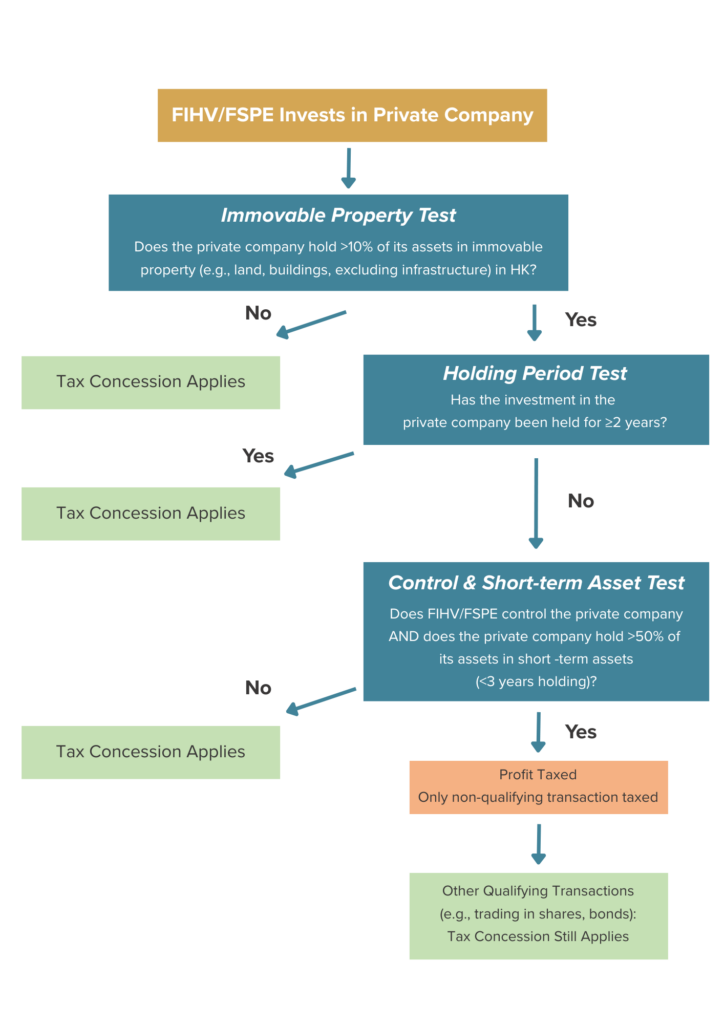
Hong Kong has implemented anti-avoidance measures to ensure that tax concessions are not abused. These measures include tests for immovable property, holding periods, and control and short-term asset tests.

Anti-Avoidance Measures

With its favourable tax regime, robust legal system, world-class financial services, skilled talent pool, and strong government support, Hong Kong is the ideal location for family office. Whether you are looking to establish a new family office or re-domicile an existing one, Hong Kong offers the perfect environment for long-term wealth planning and growth. Please contact us for further information.

Disclaimer: This article is for reference only. Nothing herein shall be construed as Hong Kong legal advice or any legal advice for that matter to any person. Oldham, Li & Nie shall not be held liable for any loss and/or damage incurred by any person acting as a result of the materials contained in this article.
Filed Under: Oln, Family Office Sevices

高李嚴律師行成立家族辦公室服務 | 鼎力支援在港國際家庭

July 6, 2026 by OLN Marketing

高李嚴律師行(Oldham, Li & Nie,簡稱 OLN)欣然宣布成立家族辦公室服務團隊,進一步提升本行在私人財富管理、信託、傳承規劃及跨境結構建領域等法律服務,以滿足國際家族日益增長的財富管理需求。

香港憑藉其普通法體制、具吸引力的稅制,以及政府多項配套支援政策,包括投資推廣署旗下家族辦公室(FamilyOfficeHK)、家族投資控股公司(FIHV)提供的稅務寬免,以及「新資本投資者入境計劃」(New CIES)。根據波士頓諮詢公司[i]發表的報告指出,香港於 2026 年已成為全球最大跨境財富管理中心,進一步鞏固了其在國際財富規劃領域的吸引力。


高李嚴律師行的家族辦公室服務團隊將提供一站式綜合法律支援,服務範疇包括:

  • 家族辦公室的設立與結構建
  • 遺囑與傳承規劃
  • 信託與資產保護
  • 複雜的遺產規劃
  • 跨境稅務與架構諮詢(包括涉及美國及法國要素)
  • 國際家族辦公室協調與統籌
  • 日常會計與財務報告
  • 外判首席財務官(CFO)及首席運營官(COO)支持
  • 專為家族辦公室及私人投資架構度身定製的策略性商業諮詢服務
  • 訴訟支援
  • 移民法

高李嚴律師行高級合夥人高國峻(Gordon Oldham)表示:「香港為期望於亞洲建立長遠發展、並與全球機遇保持緊密聯繫的家庭,提供了一個卓越的平台。 在高李嚴律師行,我們深知每個家庭的發展歷程都是獨一無二的。 憑藉我們在私人客戶、稅務及企業服務方面的長期優勢,以及我們專門的美國稅務與法國業務團隊,我們採取真正以人為本的方式,與客戶並肩同行,為其制訂出不僅能保護和增長他們的財富,亦能反映其價值觀、抱負及長遠的家族傳承。」

本行的家族辦公室服務團隊採用跨領域的協作模式,與第三方基金管理公司及財務顧問緊密合作,為客戶提供完整配套。

如欲了解更多關於家族辦公室服務的資訊,請瀏覽:https://oln-law.com/zh-hk/practice-areas/family-office-services/

[i] https://www.info.gov.hk/gia/general/202605/27/P2026052700809.htm

Filed Under: Family Office Sevices Tagged With: Estate planning, Family Office

Hidden US Tax Risks for Hong Kong Families – What Happens If Your Child Is a US Green Card Holder/ US Citizen?

June 29, 2026 by OLN Marketing

Many Hong Kong families today have children who were born in the United States or educated there and have become US citizens. At the same time, it is increasingly common for Hong Kong individuals to invest in US listed stocks given the depth and liquidity of the US market. What is often overlooked is that these two factors – US‑citizen family members and US investments – can create significant and unexpected US tax exposure.

A common misconception is that “US tax does not apply because I do not live in the US.” In reality, the combination of US‑citizen beneficiaries and US‑situs investments can bring Hong Kong families within the US tax net in ways that are not immediately obvious.

To start with, the United States operates a fundamentally different tax system than that of Hong Kong, in the sense that a US citizen is subject to tax on worldwide income regardless of where they live. As a result, a child who is a US citizen will have ongoing US tax and reporting obligations even if he or she has no intention of living in the US long term.

Separately, many Hong Kong individuals assume that because they are not US residents, US tax is not relevant to their succession planning while in fact US estate tax may kick in because such individual may have assets which are treated as “US‑situated assets”. A typical example would be US shares (including US‑listed ETFs). This gives rise to a common but frequently misunderstood risk: even if the parent is not a US person, holding US stocks directly can expose their estate to US estate tax.

This is particularly significant because the estate tax regime for non‑US individuals is extremely strict. The exemption is only USD 60,000, and any excess may be taxed at rates of up to 40%. Many Hong Kong investors holding US shares through brokerage accounts (even if such account sits in Hong Kong) may therefore have an unintended US estate tax exposure.

The risk becomes more acute in a typical family scenario – where parents hold US investments, and upon their passing, those assets are intended to pass to a US‑citizen child. Without proper structuring, US estate tax may be imposed at the estate level before any distribution is made, and the child may also face ongoing US tax and reporting obligations thereafter.

To understand more, please discuss with our professional team:

Anna W.K. Chan, Partner, Head of Tax & Private Client
Email: anna.chan@oln-law.com

Joshua D. Maxwell, US Tax Attorney
Email: joshua.maxwell@oln-law.com

Disclaimer: This article is for reference only. Nothing herein shall be construed as Hong Kong legal advice or any legal advice for that matter to any person. Oldham, Li & Nie shall not be held liable for any loss and/or damage incurred by any person acting as a result of the materials contained in this article.

Filed Under: US Tax Advisory Services, 稅務諮詢部

香港家庭隱藏的美國稅務風險 — 如果您的子女持有美國綠卡或美國公民身份,將有何影響?

June 29, 2026 by OLN Marketing

現今許多香港家庭的子女均在美國出生或在當地接受教育,並已成為美國公民。與此同時,鑑於美國市場的深度與流動性,香港個人投資者投資美股已日趨普遍。然而,大眾往往忽略了這兩個因素 — 擁有美國公民身份的家庭成員以及持有美國本土資產 ,可能會帶來重大且意料之外的美國稅務責任。

坊間常見的誤解是:「因為我不居住在美國,所以美國稅務與我無關。」然而在現實中,若將「美國公民受益人」與「位於美國境內的資產(即美國 situs 資產)」兩者結合,香港家庭便可能會以一種隱蔽的方式被納入美國的稅務網絡中。

首先,美國實行一套與香港截然不同的稅務體制。美國公民不論居住於何處,均須就其全球收入(Worldwide income)申報並繳納所得稅。因此,身為美國公民的子女,即使無意長期在美國居住,仍須承擔持續性的美國稅務申報及納稅義務。

另一方面,許多香港人士以為自己並非美國居民,因此美國稅務與其遺產承繼規劃無關。但事實上,由於該等人士可能持有被視為「位於美國境內的資產」,因而可能觸發美國遺產稅(US estate tax)。最典型的例子便是美國公司股票(包括在美國上市的交易所買賣基金,即 ETFs)。這衍生出一個普遍卻經常被誤解的風險:即使父母並非美國稅務居民(Non-US person),直接持有美股亦會導致其遺產面臨被徵收美國遺產稅的風險。

鑑於美國針對非美國居民的遺產稅制度極為嚴苛,此風險顯得尤為重大。非美國居民的遺產稅免稅額僅為 60,000 美元,任何高於此限額的應課稅遺產,其稅率最高可達 40%。因此,許多透過證券戶口(即使該戶口設於香港)持有美股的香港投資者,都可能在不經意間產生了美國遺產稅的潛在風險。

在常見的家庭場景中,此風險更為嚴峻 —— 即父母持有美國境內投資,並打算在百年歸老後將該等資產傳承予擁有美國公民身份的子女。若缺乏妥善的結構規劃,在進行任何遺產分配之前,該等資產可能已在遺產層面被徵收美國遺產稅;而子女在此後亦可能須面臨持續的美國稅務申報與納稅義務。

如欲了解更多詳情,歡迎與我們的專業團隊聯絡探討:

陳韻祺 – 合夥人,稅務諮詢及私人客户部門主管
電郵: anna.chan@oln-law.com

Joshua Maxwell – 香港註冊海外律師 (美國加州)
電郵: Joshua.maxwell@oln-law.com

免責聲明:本文僅供參考。本文中的任何內容均不得詮釋為香港法律建議或向任何人提供的任何與此相關的法律建議。對於任何人因本文所含的内容而造成的任何損失和/或損害,高李嚴律師行不承擔任何責任。

Filed Under: US Tax Advisory Services, 稅務諮詢部

Common Missteps Mainland Families Make When Handling Hong Kong Inheritances

June 15, 2026 by OLN Marketing

When a mainland Chinese entrepreneur dies leaving assets in Hong Kong, the family may discover that Hong Kong procedures are very different from those on the mainland. Bank accounts and safety deposit boxes are frozen, companies cannot be operated, property cannot be sold and the paperwork seems endless. Many of the delays and extra costs come from a small number of recurring missteps.

This article highlights six common mistakes affluent mainland families make when dealing with Hong Kong inheritances, and how these can be avoided.

Are mainland inheritance procedures sufficient for handling Hong Kong assets?

A very common misunderstanding is that once the estate has been dealt with in the PRC (for example, through a notarial inheritance certificate or a mainland court decision), banks and other institutions in Hong Kong will automatically recognise the result.

Unfortunately, this is not the case. Hong Kong has its own probate system and court procedures. Even if all the documents are in order on the mainland, a separate Hong Kong grant of representation (this is called probate where there is a will or letters of administration where there is no will ) is generally required before Hong Kong banks, brokers and the Land Registry will release or transfer assets.

While a PRC death certificate, inheritance notarisation and/or judgment constitute important evidence, these documents do not replace the Hong Kong court process.

Are “small” discrepancies overlooked or are they significant?

From a Hong Kong court’s perspective, details matter. What seems like a minor difference to a layperson can cause delays in probate. A few examples include:

  • Names spelled differently across passports, Hong Kong accounts and PRC identity cards;
  • Old hukou records that do not reflect actual family relationships;
  • Missing divorce judgments or remarriage certificates; and/or
  • Different dates of birth or inconsistent English transliterations.

Each discrepancy can trigger court questions and extra affidavits, slowing the grant. Families sometimes submit whatever documents they have, assuming they are “close enough”, and only discover later that additional notarisations, translations and/or confirmations are needed.

A more effective approach is to review all identity, marriage and hukou records at the outset, identify gaps and inconsistencies early and correct or update these before or during the Hong Kong application. This saves time and reduces the risk of requisitions from the Probate Registry.

Can one assume that “Hong Kong law applies to all assets in Hong Kong”?

Another frequent assumption is that since the assets are in Hong Kong, Hong Kong law decides who inherits the assets. The reality is more nuanced.

As a general principle:

  • Hong Kong real estate (immovable property) is governed by Hong Kong law.
  • Movable assets in Hong Kong (bank accounts, jewellery, shares, fund units) are often governed, on questions of who ultimately inherits, by the law of the deceased’s domicile at death – for many mainland entrepreneurs, this will be PRC succession law.

Domicile is not the same as nationality or simple residence; it refers to the place treated as the person’s permanent home. This becomes complicated when a person has spent long periods in Hong Kong or overseas, but keeps strong ties to the mainland.

Ignoring these issues can lead to surprises, especially where PRC and Hong Kong rules on heirs differ. Proper planning and careful analysis of domicile help to ensure that one’s intended family members actually inherit the Hong Kong assets.

Can the heirs manage everything with their mainland advisors without an experienced Hong Kong adviser?

Some families prefer to “save time and money” by handling the Hong Kong inheritance entirely from the PRC, using only PRC notaries or advisers who are unfamiliar with Hong Kong probate practices. This often leads to application forms and affidavits that do not meet Hong Kong’s formal requirements, incorrect assumptions about who has priority to apply for a grant and avoidable delays when the Probate Registry raises queries that cannot easily be answered from across the border.

The result can be months of back‑and‑forth communication, repeated document submissions and frustration for heirs who cannot access funds needed for living expenses, tax payments and/or business operations.

In practice, having a Hong Kong‑based team to manage the local court process, coordinate with mainland notaries and advise on the right strategy from day one usually proves more efficient and cost‑effective than remote trial‑and‑error.

Relying on one PRC will for everything, without checking its effect in Hong Kong

Many mainland entrepreneurs do make wills in the PRC, but do not consider how that document will operate for their Hong Kong assets.

Some common issues include:

  • The PRC will does not clearly mention overseas holdings, or uses generic wording that banks and brokers in Hong Kong find unclear;
  • No executor familiar with Hong Kong is appointed, making it harder to apply for a Hong Kong grant of probate;
  • Later wills or codicils unintentionally revoke earlier documents that were meant to cover Hong Kong assets;
  • The structure of gifts creates difficulties for Hong Kong corporate ownership interests, such as shares in a private company. For example, the will may divide the entrepreneur’s shares in a Hong Kong company in a way that does not fit how the company has been set up or how it actually runs. This can make it slower and more complicated to transfer the shares after death and to keep the business running smoothly for the family.

A single PRC will that covers “all assets worldwide” may certainly be valid in principle, but it is not always the most efficient solution for Hong Kong. In certain situations, a separate, carefully coordinated Hong Kong will (drafted to sit alongside the PRC will and not to replace it) can significantly simplify administration and reduce delays.

Is not having a will really that serious?

Finally, the most serious mistake of all may also be the most common – not making any will. Unfortunately it will already be too late for the heirs once death has occurred.

If a mainland Chinese entrepreneur dies without a valid will (i.e., intestate), several problems arise in respect of Hong Kong assets. Distribution follows fixed intestacy rules, which may not reflect the deceased’s true wishes. For example, the way assets are split between spouse, children and parents can be very different from what the entrepreneur assumed. As well, loyal employees, close friends, distant relatives and loved ones who are not close relatives will not inherit from the estate.

In an intestacy, there is no chosen executor. Family members need to decide who will apply for letters of administration and disputes often arise over this and control of the estate.

Business continuity may be affected if a Hong Kong company cannot be operated pending the grant, with no clear person authorised to make decisions.

For affluent families with cross‑border holdings, intestacy often means more time, more paperwork and more risk of conflict. A well‑structured will, or a set of coordinated wills for different jurisdictions, makes it far easier for heirs to take control of Hong Kong assets and implement the deceased’s wishes efficiently.

Conclusion Thoughtful and early planning can turn a difficult, uncertain situation into a more predictable and efficient process for a deceased’s beneficiaries. By avoiding these six common mistakes, mainland entrepreneurs and their heirs can manage Hong Kong inheritances with greater confidence and fewer unpleasant surprises during a difficult time.

Disclaimer: This article is for reference only. Nothing herein shall be construed as Hong Kong legal advice or any legal advice for that matter to any person. Oldham, Li & Nie shall not be held liable for any loss and/or damage incurred by any person acting as a result of the materials contained in this article.

Filed Under: Oln, 長者法律服務, 私人客戶 – 遺產規劃和遺囑認證

Oldham, Li & Nie Expands International Offering with Addition of Italian Registered Foreign Lawyer

May 18, 2026 by OLN Marketing

We are pleased to announce that Valerio Scimemi has joined the firm as a Registered Foreign Lawyer (Italy), further expanding OLN’s cross-border offering.

Admitted to practice law in Italy since 2001 and before the Italian and European higher courts since 2015, Valerio brings more than 25 years of international legal experience. His practice focuses on commercial and corporate law, international contracts, M&A, extraordinary transactions, and cross-border business expansion.

Over the course of his career, Valerio has advised European and Asian clients on commercial, corporate and industrial law, labour law, banking and finance, intellectual property, and complex M&A transactions. He has particular expertise in business development and intermediation, as well as in the international expansion of businesses in the luxury fashion, oil and gas, F&B, and spirits sectors.

The addition of Valerio marks another important milestone in OLN’s strategic growth and reinforces the firm’s commitment to providing seamless international legal services. His appointment builds on the firm’s established Chinese, French and Japanese practices, as well as its U.S. tax advisory capability.

For more information about Valerio and his practice, visit: https://oln-law.com/our-people/valerio-scimemi/.

Filed Under: 最新消息, 公司和商業法

  • Page 1
  • Page 2
  • Page 3
  • Interim pages omitted …
  • Page 55
  • Go to Next Page »

Primary Sidebar

This website uses cookies to optimise your experience and to collect information to customise content. By closing this banner, clicking a link or continuing to browse otherwise, you agree to the use of cookies. Please read the cookies section of our Privacy Policy to learn more. Learn more

Footer

OLN logo

香港中環雪厰街二號聖佐治大廈
五樓503室

電話 +852 2868 0696 | 電郵我們
關於 律師團隊 辦事處 OLN IP Services 私隱政策
專業服務 最新消息 加入我們 OLN Online
關於 專業服務 律師團隊 最新消息 辦事處
加入我們 OLN IP Services OLN Online 私隱政策
linkedin twitter facebook
OLN logo

© 2026 Oldham, Li & Nie. All Rights Reserved.

Manage Consent
To provide the best experiences, we use technologies like cookies to store and/or access device information. Consenting to these technologies will allow us to process data such as browsing behavior or unique IDs on this site. Not consenting or withdrawing consent, may adversely affect certain features and functions.
Functional Always active
The technical storage or access is strictly necessary for the legitimate purpose of enabling the use of a specific service explicitly requested by the subscriber or user, or for the sole purpose of carrying out the transmission of a communication over an electronic communications network.
Preferences
The technical storage or access is necessary for the legitimate purpose of storing preferences that are not requested by the subscriber or user.
Statistics
The technical storage or access that is used exclusively for statistical purposes. The technical storage or access that is used exclusively for anonymous statistical purposes. Without a subpoena, voluntary compliance on the part of your Internet Service Provider, or additional records from a third party, information stored or retrieved for this purpose alone cannot usually be used to identify you.
Marketing
The technical storage or access is required to create user profiles to send advertising, or to track the user on a website or across several websites for similar marketing purposes.
  • Manage options
  • Manage services
  • Manage {vendor_count} vendors
  • Read more about these purposes
View preferences
  • {title}
  • {title}
  • {title}
聯絡我們

請在此處分享您的訊息的詳細資訊。我們將盡快與您聯繫。

    x