Award Icon

Startup and Venture Capital Lawyers Hong Kong

Overview

Fintech and other startup businesses are powerful engines, driving economic and job growth in Hong Kong and overseas.

OLN appreciates that every Founder Entrepreneur will face difficult challenges when starting a business. Typically, that Founder Entrepreneur will turn to fellow entrepreneurs, mentors, former colleagues, incubators and friends for initial advice and assistance. That may be in respect of writing a business plan, formulating a budget, determining a corporate structure, raising money or filing documents with the Companies Registry. Whatever it is, starting a business in Hong Kong is never as straight forward and easy as it may appear.

OLN appreciates that timely practical legal advice is critical in the formative stages of any startup business, not least because “getting it wrong” could negatively impact not only on growth and financing opportunities and could also adversely affect the Founder Entrepreneur’s own equity and value in that startup business.

OLN has been actively involved with startups in Hong Kong for many years and so we fully understand that every Founder Entrepreneur wants his or her own “In House Counsel”, pragmatic lawyers who are immediately and regularly accessible and who can answer day to day questions and provide clear and strategic advice.

OLN is available to provide these services and indeed already does so for many of its clients.

The early stages of most startups will require the Founder Entrepreneur to have in place the following documents:

  • a confidentiality and non-disclosure agreement;
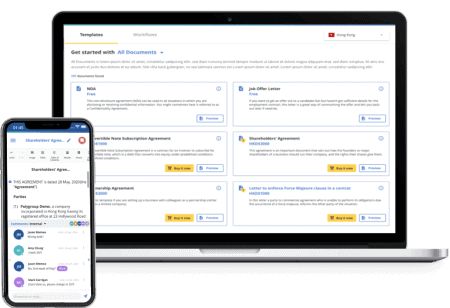
  • a subscription and shareholders’ agreement;
  • an intellectual property assignment agreement;
  • a standard employment contract;
  • a tax checklist; and
  • a checklist of regulatory restrictions.

OLN will assist with all the above aspects and documents, tailor-made to the individual requirements of the relevant Founder Entrepreneur.

OLN can provide all the necessary resources to enable every startup to commence business with the benefit of proper advice, analysis and risk management.

OLN can also assist startups with trying to obtain funding and in making all applications for relevant Hong Kong government loans.

If you want to discuss how OLN can specifically help you and how OLN can provide you with a cost-effective solution tailored to your needs, please contact us.

Startups & Venture Capital

Team Members

Our Services

Shareholding structuring Fundraising support Contract drafting and review IP protection

  • Checklist of regulatory restrictions
  • Co-Founders agreements / Collaboration Agreements / Founders’ Agreements
  • Confidentiality and non-disclosure agreements (NDA)
  • Employee share ownership schemes
  • Employment contracts and policies
  • Fundraising support
  • Intellectual property protection and licensing
  • Investment agreements / Subscription agreements
  • Legal First-aid Kit
  • Overseas expansion
  • Sustainable shareholding structuring
  • Tax checklist
  • Website terms of use
  • achievements

    Awards & Recognitions

    TESTIMONIALS

    What Our
    Clients Say

    Startups & Venture Capital Law FAQs

    What legal structure should a Hong Kong startup use? +

    A private limited company incorporated in Hong Kong is the default, and for good reason: limited liability, fast setup (3–5 working days, official fee around HK$1,720), and it’s the structure institutional investors expect before they’ll wire money.
    The more interesting question is what sits above it. Founders eyeing US venture capital or a US listing often add a Cayman or BVI holding company on top of the Hong Kong operating entity. That’s a real optionality decision with real cost.
    So the honest answer: don’t reach for the offshore holdco reflexively. Build it when a specific fundraising or exit path calls for it — not because a deck told you serious startups have one.

    What is a Shareholders’ Agreement, and does every startup need one? +

    A Shareholders’ Agreement — often called a Co-founders’ Agreement when it’s the founding team papering how they’ll work together — sets out, in advance, how shareholders behave when they disagree: voting rights, founder vesting, transfer restrictions, pre-emption, tag-along and drag-along, and how someone exits.

    It’s usually sensible for a company with more than one founder, though not an absolute rule. A very early single-founder company, or one where well-drafted Articles already cover the ground, may not need a separate agreement on day one.

    But the framing matters more than the label. It isn’t a weapon you draft for the day you sue each other — it’s a relationship tool.

    This is also where an experienced lawyer earns their fee rather than sending a template. A precedent SHA lists the right clauses; it won’t ask whether your 50:50 split has a deadlock-breaker, whether vesting reflects who’s actually full-time, or what happens when a founder’s circumstances change. Those awkward day-one conversations are exactly the ones that quietly destroy companies when left to goodwill. Having the conversation early is the point. The document just records it.

    What is an IP assignment agreement, and why does it matter? +

    It transfers ownership of everything the founders built before incorporation — code, designs, brand, content — from the individuals to the company.

    This one is deceptively load-bearing. Founders assume that because they built it “for the startup,” the startup owns it. Legally, it doesn’t. Until assignment happens, the IP sits with the individual — and a diligence lawyer will find that gap in minutes and stall your round over it.

    We treat IP assignment as a standard part of formation, not a fundraising fire drill. Cleaning it up under deal pressure is far more expensive than doing it on day one.

    What’s the difference between a convertible note and a SAFE? +

    A convertible note is debt: it accrues interest, has a maturity date, and converts to equity at a later priced round.

    A SAFE (Simple Agreement for Future Equity) isn’t debt — no interest, no maturity. It simply converts on a trigger event, like your next round. SAFEs are increasingly common in early-stage Hong Kong deals because they’re faster and cheaper to paper.

    The catch founders under-appreciate: “simple” refers to the document, not the dilution. Valuation caps and discounts stack quietly across multiple SAFEs, and you can give away far more of the company than you realised by the time everything converts. Model the cap table before you sign, not after.

    What does a typical Series A term sheet contain in Hong Kong? +

    The core components look much like Silicon Valley or Beijing: pre-money valuation, investment amount, share class and its rights (liquidation preference, anti-dilution), board composition, pro-rata rights, information rights, drag-along, founder lock-up and vesting, and an exclusivity period. Hong Kong term sheets don’t diverge dramatically from that global template.

    Where founders get caught out is the tailoring. Plenty of Hong Kong deals carry bespoke investor requests that aren’t in any standard form — a particular consent right, a specific reporting cadence, protections tied to that investor’s own mandate. These deserve as much attention as the headline terms.

    Incubator and accelerator involvement is another local wrinkle. If a programme holds options or shares from an earlier stage, that sits on your cap table and can interact with the new investor’s economics and rights in ways founders don’t anticipate.

    And the place control is actually won or lost is rarely the valuation everyone fixates on. It’s the governance terms: board seats, reserved matters, the shape of the liquidation preference. A slightly lower valuation with clean control terms almost always beats a headline number wrapped in rights that hollow out your ability to run your own company.

    When does a Hong Kong startup need to register with the SFC? +

    If your model involves dealing in securities, asset or fund management, advising on investments, or running certain payment or virtual-asset activities, you may need an SFC licence or HKMA registration.

    The mistake we see most is treating this as a compliance step for “later.” Licensing questions should sit inside your business-model design from the start — because the answer can reshape the model itself. Building for eighteen months only to discover you needed authorisation before your first dollar is an expensive way to learn it.

    What government funding is available for Hong Kong startups? +

    The main schemes are the Innovation and Technology Fund (ITF) for R&D projects, the Technology Voucher Programme (TVP) to co-fund tech adoption, the BUD Fund for brand-building and market expansion, and the SME Export Marketing Fund.

    One caution before you build a plan around any of them: eligibility criteria, ceilings, and matching requirements change, and the headline numbers are almost never what lands in your account. Confirm the current terms with the administering body before you count on a figure.