• Skip to primary navigation
  • Skip to main content
  • Skip to primary sidebar
  • Skip to footer
location iconSuite 503, 5/F, St. George's Building, 2 Ice House Street, Central, Hong Kongphone-icon +852 2868 0696 linkedintwitterfacebook
OLN IP Services
close-btn
OLN IP Services
Get bespoke and commercially-driven advice to your Intellectual Property
Learn More
OLN IP Services
OLN Online
close-btn
OLN Online
Powered by Oldham, Li & Nie, the law firm of choice for Hong Kong’s vibrant startup and SME community, OLN Online is a forward-looking and seamless addition to traditional legal services – a true disruptor.
Learn More
OLN IP Services
OLN CS
close-btn
OLN CS
OLN was established in 1987 by Gordon Oldham with the goal of providing both quality legal advice and practical legal solutions to the business community.
Learn More
OLN CS Services
  • IT
    • ENG
    • 简
    • 繁
    • FR
    • 日本語
Oldham, Li & Nie
OLN IP Services
close-btn
OLN IP Services
Get bespoke and commercially-driven advice to your Intellectual Property
Learn More
OLN IP Services
OLN Online
OLN CS
close-btn
OLN Online
Powered by Oldham, Li & Nie, the law firm of choice for Hong Kong’s vibrant startup and SME community, OLN Online is a forward-looking and seamless addition to traditional legal services – a true disruptor.
Learn More
OLN IP Services
  • Chi Siamo
    • Premi e Riconoscimenti
    • Impegno verso la Comunità
  • Persone
  • Aree di Attività
  • Insights
  • Sedi

Suite 503, St. George's Building,
2 Ice House Street, Central, Hong Kong

Tel. +852 2868 0696 | Send Email
linkedin twitter facebook
OLN Blue

OLN Law

  • Aree di Attività
  • Awards and Rankings
  • Block Content Examples
  • Careers
  • Chi Siamo
    • Corporate Social Responsibility
    • Premi e Riconoscimenti
  • Client Information & Registration
  • Contact Us
  • Cookie Policy (EU)
  • Globalaw
  • Oldham, Li & Nie
  • OLN Podcasts
  • Persone
  • Privacy Policy
  • Review
  • Reviews
  • Sedi
  • Standard Terms of Engagement
  • Chi Siamo
    • Premi e Riconoscimenti
    • Impegno verso la Comunità
  • Persone
  • Aree di Attività
  • Insights
  • Sedi

Insight from the Recent CFA decision in Commissioner of Inland Revenue v Poon Cho Ming, John – Whether Benefits Received on Termination of Employment are Taxable or Not

Test Blog

Insight from the Recent CFA decision in Commissioner of Inland Revenue v Poon Cho Ming, John – Whether Benefits Received on Termination of Employment are Taxable or Not

30 Novembre 2021 by OLN Marketing

Employee termination is not uncommon during economic downturn or group restructuring. The termination payments or the compensation packages, especially for top executives or senior employees, often consist of many components such as salaries, gratuities, discretionary bonuses, golden handshakes, settlement sum for the employment dispute. Given the diversified nature of the compensation components, it might not be easy to identify which part of entire package is taxable and which is not under the definition of section 8(1) of the Inland Revenue Ordinance, Cap. 112 (“IRO”).

As a starting point, the IRO provides that only income earned in the course of employment is chargeable to salaries tax. It is however not always easy to determine which compensation component has direct corelation to the employment and which is not. The precedent case, Fuchs v Commissioner of Inland Revenue [2011] 14 HKCFAR 74, offers some guidance on this issue. The Court ruled in Fuchs that what an employee received in satisfaction of his rights under his contract of service was taxable, while what he received in abrogation of his rights under the contract was not taxable.

The Court of Final Appeal has reaffirmed such position in its recent decision in Commissioner of Inland Revenue v Poon Cho Ming, John [2019] HKCFA 38 whereby it was held that rewards for past services and inducements to enter into employment and providing future services are chargeable under the said provision, whereas payment which were for something else were not chargeable. This article seeks to discuss the legal principles concerning the subject matter and how unnecessary dispute could be avoided.

A. Brief facts in Poon Cho-Ming case

The Respondent Taxpayer (‘Respondent’) was employed as a director of the Company pursuant to a written employment contract dated 20 October 1999 (‘Service Agreement’). In July 2008, his employment was abruptly terminated without cause. The Respondent and the Company entered into negotiations, with legal representatives on both sides, which resulted in a separation agreement dated 20 July 2008 (‘Separation Agreement’) to terminate the employment on the same day.

During the employment, the Respondent was eligible to be considered for a discretionary bonus and for the grant of unvested share options under an employee’s shares option scheme. Under the scheme, Options granted in one year would vest, provided the Respondent was still employed by the company, in annual tranches over the following 5 years.

After the termination of his employment, the Respondent received payments and benefits from the Company and were taxed by the Commissioner of Inland Revenue. The items that were in disputes are as follows.

  1. EUR500,000 provided for under the Separation Agreement, labelled as a ‘payment in lieu of a discretionary bonus’ (‘Sum D’); and
  2. the amount derived from the exercise of the Respondent’s share options which the Company agreed under the Separation Agreement to vest on an accelerated basis (‘Share Option Gain’).

The Commissioner of Inland Revenue, the Board of Review and the Court of First Instance considered and ruled that the above sums constituted income ‘from’ the Respondent’s employment and were therefore chargeable to Salaries Tax under section 8(1) of the IRO.

The Respondent appealed to the Court of Appeal which overturned the CFI’s decision. The Court of Final Appeal upheld the decision of the Court of Appeal and unanimously decided that the above sums were ‘for something else’ and were not therefore taxable under section 8(1) of the IRO.

B. The relevant legal principles

The ‘operative test’ is succinctly summarized by Ribeiro PJ in Fuchs (at para 22).

In short, the question that needs to be asked is: ‘in the light of the terms on which the taxpayer was employed and the circumstance of the termination, what, in substance not form, the sum and benefits is for?’

If the purpose or nature of the payment constitutes income from employment, the payment is taxable under s.8(1) IRO, as illustrated in the table below.

 Purpose or nature of the paymentIncome from employment
(s. 8(1) IRO)
Taxability
1‘acting as or being an employee’YesYes
2 ‘as a reward for past service’ Yes Yes
3 ‘as an inducement to enter employment or for future services’ Yes Yes
4‘for something else’NoNo
C. Application of the test to the facts of Poon Cho-Ming Case

In Poon Cho-Ming case, the IRD was of the view that both Sum D (i.e. the payment in lieu of discretionary bonus) and Share Option Gain were employment income because “discretionary bonus” was employment performance-linked and Share Option Gain was derived from employee benefit scheme. 

The Court, however, was of the view that both Sum D and Share Option Gain were not Respondent’s entitlement under the terms of the Service Agreement, nor had he any accrued rights on his termination which he could enforce at law in relation to them.

Although Sum D was described as a substitution of the discretionary bonus, the Court preferred substance over form. The Court analysed the facts and found that Sum D is, in substance, materially different from the discretionary bonus, in term of their purpose and nature. The amount of Sum D was arrived arbitrarily by way of negotiation between the Respondent and the CEO of the company, without reference to the performance of the Respondent and other considerations or procedure which would have been relevant in determining discretionary bonus in the Company.

The Court also found that the accelerated vesting of the share options under the Separation Agreement constituted a new right. With regard to the terms of the Grant Letters, the Court found that the original right was plainly not exercisable on the separation date and would have lapsed if the Respondent was no longer an employee of the Company. The new right under the Separation Agreement replaced the original right under the Service Agreement, allowing the Respondent to exercise the share options within 3 months from the separation date when he was no longer an employee of the Company.

The Court of Appeal concluded (and the CFA agreed) that the purpose of Sum D and Share Option Gain were for something else. The aforesaid benefits were found to be the consideration for the Respondent Taxpayer agreeing to:-

  1. ‘go quietly’ with a joint announcement that he had ‘resigned’ to mitigate adverse market reaction;
  2. additional post-employment covenants in the Separation Agreement which created new obligations on him; and
  3. settle or abrogate any and all claims which he might have against the Company arising from the termination of his employment.
D. Insight from Poon Cho-Ming case

The CFA’s decision in Poon Cho-Ming has reaffirmed the orthodox position as set down in precedents. However, the application of the legal principles is not a straightforward exercise. Detailed analysis of the facts in each case is required. How the termination letter or the separation agreement is crafted and the wordings therein could lead to unnecessary confusion and debate.

To avoid the hassle of litigation, the employers and/or taxpayers should involve legal representatives in the early stage of termination process. A well-structured termination package, careful drafting of agreements as well as appropriate responses to the Authorities will help reflect the true intent and nature of the termination payment and save taxpayers from unnecessary tax exposure.

Our firm has extensive experience in advising on employment-related matters and on tax advisory matters. If you have any question regarding the topic discussed above, please contact our partner Anna Chan at anna.chan@oln-law.com for further assistance.

Disclaimer: This article is for reference only. Nothing herein shall be construed as Hong Kong legal advice or any legal advice for that matter to any person. Oldham, Li & Nie shall not be held liable for any loss and/or damage incurred by any person acting as a result of the materials contained in this article.
Filed Under: Senza categoria, Tax Advisory, Employment and Business Immigration Law

Reproductive Technology in Hong Kong – Legal Framework, Ethics and Emerging Judicial Trends

24 Agosto 2026 by OLN Marketing


(This article was published in the August 2026 Issue of the Hong Kong Lawyer)

Introduction

Louise Joy Brown, born in Manchester on 25 July 1978, was the world’s first baby conceived via in vitro fertilisation (“IVF”). Eight years later, Hong Kong’s first IVF baby was born in December 1986 at a private hospital in Happy Valley. His birth at the time was so controversial that his parents declined to reveal his and their identities, as well as his birthdate. As reported in the South China Morning Post, the Catholic Church had condemned the procedure as “an artificial manoeuvre to create life”.

Today it is estimated that 57 IVF babies are born every hour globally. Technological advancements over the years have rendered IVF procedures more mainstream, safer and success rates much higher.

Meanwhile in Hong Kong, the total fertility rate has been below the replacement level of 2.1 for decades, and even plunged to a record low in 2025. The HKSAR government’s recent efforts to reverse this trend include a one-off cash allowance of $20,000 for babies born between 25 October 2023 – 24 October 2026, increased child tax allowance, a “families with newborns allocation priority scheme” for public housing, increased childcare centres, increased quota for  IVF treatment within the public medical system and a new tax deduction for medical expenses related to assisted reproductive services.

In December 2025, the Human Reproductive Technology (Licensing) (Amendment) Regulation 2025 L.N. 160 of 2025 removed the previous 10-year statutory limit on own-use gamete and embryo storage. This is a significant change that aligns with modern international norms and advances reproductive autonomy.

Another area of reform that has been debated is updating the Human Reproductive Technology Ordinance, Cap 561 (“HRTO”). Enacted in 2000, the HRTO is the principal legislation that governs human reproductive technology (“RT”) procedures in Hong Kong. The HRTO at present effectively ringfences access to RT procedures (other than egg freezing) to “parties to a marriage”. Same sex marriage is not yet recognised under Hong Kong laws, leaving access to infertile, married heterosexual couples. Commercial surrogacy is also prohibited under the HRTO.

Principal Legislation

The HRTO preamble states that it is an ordinance “to regulate reproductive technology procedures, and the use, for research and other purposes, of embryos and gametes; to confine the provision of reproductive technology procedures to infertile couples subject to any express provision to the contrary in any code; to regulate surrogacy arrangements; to establish a Council on Human Reproductive Technology; and to provide for matters incidental thereto or connected therewith”.

Regulatory Body and Licensing

Pursuant to the HRTO, s.5, the Council on Human Reproductive Technology (“CHRT”) is the statutory body charged with a number of statutory functions under the HRTO, including licensing and policy-related duties..

Definitions

Reproductive technology procedures are defined in the HRTO as,

“…a medical, surgical, obstetric or other procedure (whether or not it is provided to the public or a section of the public) assisting or otherwise bringing about human reproduction by artificial means, and includes—

(a)in vitro fertilization;

(b)artificial insemination;

(c)the obtaining of gametes;

(d)manipulation of embryos or gametes outside the body;

(e)a procedure specified in a notice under subsection (2)(a)(ii) to be a reproductive technology procedure; and

(f)a gender selection achieved or intended to be achieved by means of a procedure which falls within this definition,

but excludes a procedure specified in a notice under subsection (2)(b)(ii) not to be a reproductive technology procedure;”.

The HRTO does not define infertility. There is a general reference in the preamble to confining reproductive technology procedures to infertile couples. The World Health Organization defines infertility as “a disease of the male or female reproductive system defined by the failure to achieve a pregnancy after 12 months or more of regular unprotected sexual intercourse” and this is a generally accepted definition for practical purposes.

Code of Practice and Professional Standards

Pursuant to the HRTO, s.8, the CHRT shall issue and maintain a Code of Practice on Reproductive Technology and Embryo Research (“Code”), which sets out detailed guidelines for RT service providers and embryo researchers. The Code first came into effect on 1 August 2007. 

The preamble of the Code states that while it provides guidance and minimum standards to safeguard the health and interests of service users and to protect the welfare of children born via RT, professionals concerned should still follow the codes of practice and professional ethics of their own disciplines, which the Code does not supersede.

Eligibility

The HRTO, s.15(5) restricts RT procedures being provided to persons who are parties to a marriage. Read in conjunction with the preamble to the HRTO and the Code paragraph 4.2 which refer specifically to infertile couples, in general only infertile married couples are treated in practice as able to avail themselves of RT procedures except this shall not apply to surrogate mothers pursuant to section 15(6) or couples who are permitted to use embryo sex selection for medical conditions e.g., to avoid serious sex linked diseases, pursuant to section 15(3) and as specified in Schedule 2 of the HRTO.

Since the preamble of the HRTO and Chapter IV of the Code state that RT procedures should only be made available to infertile couples, RT procedures for social or non medical reasons are not generally permitted except in very limited circumstances.

Specific Exclusions and Exceptions

Single persons, cohabiting heterosexuals who are not married and same sex couples are not eligible to receive RT procedures as the HRTO generally limits treatment to persons who are parties to a marriage as interpreted under current laws (the Code paragraph 4.1 note 12).

Within that framework, the HRTO allows for narrowly defined exceptions such as under section 15(7) which allows the continuation of an RT procedure where the couple was married at the time gametes or an embryo were first placed in the woman’s body, even if the marriage has subsequently ended. Another example is embryo sex selection to avoid serious sex linked diseases. Schedule 2 (and its amendment) of the HRTO specifies the sex linked diseases for which embryo sex selection is permitted.

While it appears that those who are legally allowed to avail themselves of RT procedures in Hong Kong are adequately protected and supported, those who do not fit within the current legal framework (such as singles, unmarried heterosexual couples, same sex couples) remain effectively excluded, regardless of their reproductive circumstances and Hong Kong’s alarming birth rate.

​The HRTO and the Code restrict the provision of RT procedures, in general, to infertile, married heterosexual couples. Same sex couples and single persons are excluded from the vast majority of RT procedures under current legislation.

Commercial transactions in (the buying and selling of) embryos, gametes and surrogacy are prohibited. Hence, only altruistic donations of embryos, gametes and surrogacy arrangements are permitted although reimbursement of legitimate expenses is allowed, in accordance with the HRTO, s.16 and s.17. Appendix II of the Code sets out guidelines on reimbursing donors.

Emerging Judicial Trends

While legislation has been updated at a slow pace, case law sits at the intersection of law, evolving ethics and current public policy. In Re A and Another HKCFI 1749; 5 HKLRD 366 (HCMP 1571/2018, Au-Yeung J, 14 October 2019), the court had extended the statutory 6 month time limit in the Parent and Child Ordinance Cap 429 s.12(2) and retrospectively approved commercial surrogacy payments despite the illegality of commercial surrogacy arrangements in Hong Kong because 1) the applicants acted in good faith without moral taint or intent to defraud, 2) the payments were not so disproportionate as to offend public policy and 3) the A & B v E ** HKCFI 3143** (HCMP 731/2023…) parental order was in the best interests of the children vis-a-vis their lifelong welfare and legal identity. Au-Yeung J applied and elaborated the same analytical framework in A & B v E HKCFI 3143 (HCMP 731/2023, Au-Yeung J, 4 December 2023).

The above two cases, together with CS v SW HKCFI 2326 (HCMP 1731/2023, Au-Yeung J, 25 September 2024) and HSC v T; HSC v D HKCFI 770 (HCMP 706–707/2025, Au-Yeung J, 2 February 2026) form an emerging body of case law that points to Hong Kong courts granting parental orders and approving commercial surrogacy payments made in good faith, always with an overriding concern for the lifelong welfare of the child. In the latter case, the court again granted parental orders and approved separate commercial surrogacy payments for two oral surrogacy arrangements made in Shenzhen with two surrogates and extended the deadline of the statutory 6 month time limit in the Parent and Child Ordinance Cap 429, s.12(2). The lifelong best interests of the two children were considered. Rather than deliberately committing a breach, the commissioning parents had unfortunately acted without obtaining proper legal advice and had been ignorant of the law.

Surrogacy and Legal Parenthood

Surrogacy arrangements fall within the purview of the HRTO. The preamble of the HRTO sets out its mandate to “to confine the provision of reproductive technology procedures to infertile couples subject to any express provision to the contrary in any code”. Pursuant to the Code paragraph 12.2(b), a RT procedure may only be provided if the wife in that marriage is unable to carry a pregnancy to term and no other treatment option is practicable. In accordance with the Code paragraph 12.7, counselling by a multi-disciplinary team must be provided to all parties in the surrogacy arrangement, including the husband of the surrogate, if any.

Surrogacy is only permitted in altruistic circumstances and not on a commercial basis. Pursuant to the HRTO, s.17, there is a prohibition on surrogacy arrangements on a commercial basis. The Code paragraph 12.1 cross references the prohibition.

No surrogacy arrangement is enforceable by law under the HRTO, s.18 and as set out per the Code paragraph 12.6. As well, all parties to a surrogacy arrangement should be informed that the surrogacy arrangement is not enforceable.

The Code paragraph 12.8 sets out the suitability criteria by which commissioning couples and their surrogates must be assessed, taking into account their physical, mental and social well being. The surrogate must be at least 21 years of age (the Code paragraph 12.4).

The Parent and Child Ordinance Cap 429, s.9 states that the woman who gives birth is treated by law as the child’s mother (and if she is married and her husband has consented, he is treated by law as the child’s father) despite any surrogacy agreement that is in place. Section 12(2) prescribes that a commissioning couple must apply to the court within six months of their child’s birth for a parental order, and the court may make such a parental order provided all the conditions of subsections 12(1) – (7) have been met.

In the case of HC v WYH HKCFI 1157 (HCMC 3/2023, Chu J, 30 April 2024), the parties were married but subsequently separated. The issue before the court was whether the lack of parental orders or adoption orders (the two children in question were born out of commercial surrogacy arrangements made in California) were obstacles to the Family Court making orders in the best interests of the children as they were “children of the family”.

The court ruled that the statutory definition of “child of the family” as set out in section 2 of the Matrimonial Proceedings and Property Ordinance Cap 192 is broad and autonomous and children born of commercial surrogacy arrangements fall within the definition (without adoption or parental orders in place), giving the court jurisdiction to make custody and maintenance orders in divorce proceedings.

In the case of CS v SW HKCFI 2326, HCMP 1731/2023 (25 September 2024, Au-Yeung J), the court ruled that the children’s best interests and the need for secure lifelong legal status with their de facto parents outweighed the serious breaches of Cambodian, Thai and Hong Kong laws regarding commercial surrogacy and a delay of over 4 years beyond the statutory limit specified in the Parent and Child Ordinance Cap 429 s.12(2).

Sanctions and Enforcement

Breaching the HRTO may be a criminal matter and may lead to fines, imprisonment and regulatory sanctions including the loss of professional licences for practitioners and researchers.

Conclusion

Hong Kong’s legal framework in respect of RT was enacted a quarter century ago. The December 2025 removal of the 10-year limit on gamete and embryo storage was a welcome modernisation although the foundational framework for eligibility and access to RT remains the same.

The more significant developments have come from the judicial rather than legislative front – the four seminal cases discussed above have established that the courts will grant parental orders and approve commercial surrogacy payments made by commissioning parents where they acted in good faith (often in ignorance of their legal positions), the payment amounts were not disproportionate and the child’s best interests were taken into account.

The gap between what the HRTO prohibits and what courts have been willing to regularise is widening. Children born into this tenuous legal environment deserve legal certainty beyond what the courts have been able to grant. Hong Kong’s record low birth rate should tilt economic and social policy towards inclusive legislative reforms that follow judicial developments. Until then, those who are being denied access to RT procedures in Hong Kong will continue to search overseas for solutions.

Disclaimer: This article is for reference only. Nothing herein shall be construed as Hong Kong legal advice or any legal advice for that matter to any person. Oldham, Li & Nie shall not be held liable for any loss and/or damage incurred by any person acting as a result of the materials contained in this article.

Filed Under: Senza categoria, Elder Law Practice Group

New Rules, New Risks: Navigating China’s 2027 Trademark Law

5 Agosto 2026 by Anastasia

On 26 June 2026, the Standing Committee of the 14th National People’s Congress passed a landmark revision of the Trademark Law of the People’s Republic of China, which will come into force on 1 January 2027. This marks the first comprehensive overhaul since the law’s introduction in 1983, expanding the framework from 8 chapters and 73 articles to 9 chapters and 87 articles.

More significantly, the revision reflects a fundamental shift in legislative philosophy – from a system that primarily encouraged registration to one that emphasizes genuine use and market order. For brand owners operating in or entering China, the transition period leading up to 2027 is strategically important.

Key Legislative Shifts

The revised law introduces several structural changes that will directly impact trademark filing and enforcement strategies.

1. Stricter Controls on Malicious Filings

The new law explicitly prohibits trademark applications filed without intent to use and exceeding normal business needs. To enforce this, the authorities have introduced quantitative examination criteria in updated guidelines:

  • Applying for 50 or more trademarks within 12 months without a clear commercial rationale
  • Filing 10 or more trademarks across unrelated industries in a single batch
  • Targeting well-known names, internet trends, or generic industry terms

Applications meeting these thresholds may be rejected at the examination stage, and applicants risk being placed on regulatory watchlists. This signals a decisive move against trademark hoarding and bad-faith filings.

2. Increased Liability for Deceptive Use

The law now classifies misleading use of registered trademarks as a punishable offence. This includes branding strategies that rely on wordplay or presentation likely to confuse consumers.

Penalties may reach up to five times the illegal gains, capped at RMB 250,000. Failure to rectify violations within a prescribed period may result in revocation of the trademark registration.

3. Recognition of Digital Use

Trademark “use” is now expressly extended to online and digital environments. Acceptable evidence includes:

  • E-commerce listings and online storefronts
  • Social media accounts and promotional content
  • Livestreaming and digital marketing activities
  • NFTs and digital collectibles displaying the mark

This clarification significantly lowers evidentiary uncertainty for online businesses and aligns the law with modern commercial practices.

4. Expanded Protection for Unregistered Well-Known Marks

Foreign brand owners entering China may benefit from enhanced protection even prior to registration. The revised law allows recognition of well-known trademark status, which can be invoked to support invalidation or opposition actions against bad-faith filings across different classes.

Enhanced Regulatory Oversight

The revised law also strengthens enforcement mechanisms and imposes greater compliance obligations.

1. Proactive Revocation for Non-Use

Authorities are now empowered to initiate revocation actions against trademarks that have not been used for three consecutive years, without requiring a third-party challenge. This increases the risk of maintaining defensive or unused registrations.

2. Earlier Evidence Cut-Off

The evidentiary window for proving use has shifted to the three years preceding the alleged infringement, rather than the commencement of legal proceedings. This limits the effectiveness of last-minute or “token” use.

3. Shortened Opposition Period

The opposition period has been reduced from three months to two months, requiring more efficient trademark monitoring and faster decision-making by brand owners.

4. Increased Liability for Trademark Agencies

Trademark agencies that knowingly assist in bad-faith filings may face administrative penalties, including suspension or revocation of their business licences. This is likely to improve overall filing quality and professional accountability.

New Types of Protection and Procedural Changes

The revision also introduces protections for emerging forms of branding and tightens procedural strategies.

  • Dynamic trademarks, including animated logos and sequential marks, are now explicitly recognised
  • Limitations have been placed on delaying tactics in examination and litigation, reducing opportunities for procedural abuse
Practical Implications for Brand Owners

The 2027 Trademark Law signals a transition from a volume-driven filing strategy to one focused on substantiated commercial use. Businesses should:

  • Review existing portfolios to identify unused or vulnerable marks
  • Ensure consistent and well-documented use, particularly in digital channels
  • Reassess filing strategies to avoid excessive or unjustified applications
  • Strengthen monitoring systems to meet shorter opposition timelines

For example, a company that previously filed broad defensive applications across multiple unrelated classes may now face rejection or regulatory scrutiny. A more targeted, use-based filing strategy supported by evidence will be essential.

Conclusion

China’s revised Trademark Law represents a decisive move toward a more disciplined and use-oriented trademark system. The emphasis is no longer on securing as many registrations as possible, but on demonstrating genuine commercial use and maintaining orderly competition.

Brand owners who proactively adapt their strategies – by aligning registrations with actual business activities and strengthening evidence of use – will be better positioned to protect and enforce their rights in this evolving legal landscape.

Disclaimer: This article is for reference only. Nothing herein shall be construed as Hong Kong legal advice or any legal advice for that matter to any person. Oldham, Li & Nie shall not be held liable for any loss and/or damage incurred by any person acting as a result of the materials contained in this article.

Filed Under: Senza categoria, Intellectual Property

Family Offices in Hong Kong: Tax Concessions, Re-domiciliation, and Proposed 2026 Reform

7 Luglio 2026 by OLN Marketing

Hong Kong stands out as a premier destination for family offices, offering a unique blend of business-friendly policies, robust legal frameworks, and strategic advantages.

1. Business-Friendly Tax Regime

Hong Kong imposes low and simple taxes with no VAT, capital gains, dividend, or inheritance taxes. As at June 2026, Hong Kong holds 58 comprehensive avoidance of double taxation agreements, with another 16 under negotiation.

2. Robust Legal System

The city operates under a Common Law framework, providing strong rule of law and investor protection.

3. World-Class Financial Services

As a leading global hub for private banking, asset management and professional advisory services, Hong Kong offers tailored solutions for HNWIs and families.

4. Skilled Talent Pool

Hong Kong is home to a highly skilled, multilingual workforce.

5. Government Support

The Hong Kong government actively supports family offices through initiatives like FamilyOfficeHK under InvestHK and tax concessions for single-family offices.

6. Strategic Location

Hong Kong serves as a gateway to Mainland China and the Asia-Pacific region.

Re-Domiciliation of Family Offices

As of May 2025, non-Hong Kong incorporated companies, including family offices, can re-domicile to Hong Kong under a new statutory regime. This allows family offices to relocate their operations while retaining their legal identity and continuity. The streamlined process involves an application to the Companies Registry, with approvals typically granted within two weeks.

Key highlights:

  • The family office retains all assets, rights, obligations, and legal standing post-transfer
  • The family office obtains the same rights as family offices incorporated in Hong Kong
  • A fixed application fee (HK$6,050 electronically / HK$6,725 in hard copy)
  • Upon approval, the family office becomes a Hong Kong-incorporated entity and must deregister in its original jurisdiction within 120 days

Regulatory and tax implications:

  • Tax continuity is preserved – profits tax applies only to income sourced in Hong Kong
  • Relief and credits are available to avoid double taxation during transition
  • No stamp duty is triggered by re-domiciliation

Tax Concessions for Family-owned Investment Holding Vehicles (FIHVs)

Hong Kong’s Inland Revenue (Amendment) (Tax Concessions for Family-owned Investment Holding Vehicles) Ordinance 2023 introduced a 0% profits tax concession for qualifying FIHVs.

Who qualifies:

  • ≥ 95% beneficial interest held, in aggregate, by one or more than one member of the family (charities ≤ 25%, outsiders ≤ 5%)
  • Normally managed and controlled in Hong Kong, outsourcing is permissible
  • Holds ≥ HK$240 million specified assets (shares, stocks, bonds, debentures, etc.)
  • Carries on all core income-generating activities in Hong Kong with ≥ 2 qualified full-time staff and ≥ HK$2 million local operating spend
  • Not a business undertaking

What’s covered:

  • Transaction in specified assets (qualifying transactions): trading securities, FX, private-company shares, derivatives, etc.
  • Transactions incidental to the carrying out of qualifying transactions (receipts capped at 5% of total receipts)

Practical steps to obtain tax certainty:

  1. Map ownership to confirm ≥ 95% family control (with any charity/unrelated shareholding within limits).
  2. Elect for the concession – once, in writing – before filing the first relevant tax return.
  3. Verify substance annually: head-count, spend, and asset NAV.
  4. Monitor transactions for the 5% incidental threshold and private-company anti-avoidance triggers.
  5. Maintain documentation (family tree, group chart, management agreements, NAV calculations) ready for audit or advance-ruling submission.

Legislative Update: 2026 Preferential Tax Regimes Bill

  • On 12 June 2026, Hong Kong gazetted the Inland Revenue (Amendment) (Preferential Tax Regimes for Funds, Family-owned Investment Holding Vehicles and Carried Interest) Bill 2026.
  • The Bill proposes to expand Hong Kong’s preferential tax regimes for:
    • funds;
    • Family-owned Investment Holding Vehicles;
    • carried interest.
  • Expanded qualifying asset classes
    • The 0% profits tax concession would be expanded to cover additional asset classes, including:
      • digital assets;
      • gold and other precious metals;
      • specified commodities;
      • carbon credits;
      • private credit.
  • Broader eligible fund structures
    • Eligibility would be extended beyond traditional open-ended fund structures to include:
      • certain “fund-of-one” structures;
      • wholly-owned investment vehicles;
      • pension funds;
      • charity funds.
  • Carried interest tax relief
    • The Bill would enhance tax relief for performance-linked returns, including carried interest, for private equity and venture capital funds.
    • This is intended to strengthen Hong Kong’s competitiveness as a private capital and asset management hub.
  • Removal of 5% incidental threshold
    • The existing draft memo states that the concession covers transactions in specified assets and that receipts from incidental transactions are capped at 5% of total receipts.
    • The Bill proposes to remove this 5% incidental threshold, giving family offices greater flexibility in treasury, cash management and interest-earning activities.
  • Interaction with non-tax incentives
    • Hong Kong’s Capital Investment Entrant Scheme provides a residency pathway for individuals making a qualifying HK$30 million investment, including at least HK$3 million into a government-managed investment portfolio.
    • The scheme may also allow family members to be included, facilitating relocation alongside the family office structure.

Anti-Avoidance Measures

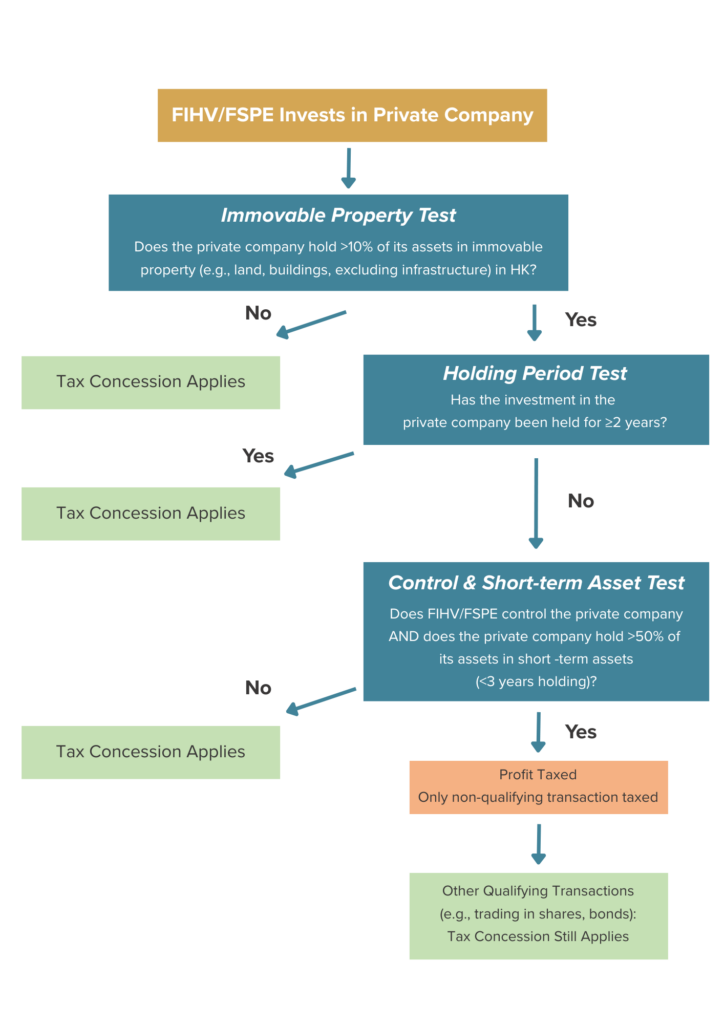
Hong Kong has implemented anti-avoidance measures to ensure that tax concessions are not abused. These measures include tests for immovable property, holding periods, and control and short-term asset tests.

Anti-Avoidance Measures

With its favourable tax regime, robust legal system, world-class financial services, skilled talent pool, and strong government support, Hong Kong is the ideal location for family office. Whether you are looking to establish a new family office or re-domicile an existing one, Hong Kong offers the perfect environment for long-term wealth planning and growth. Please contact us for further information.

Disclaimer: This article is for reference only. Nothing herein shall be construed as Hong Kong legal advice or any legal advice for that matter to any person. Oldham, Li & Nie shall not be held liable for any loss and/or damage incurred by any person acting as a result of the materials contained in this article.

Filed Under: Senza categoria, Family Office Sevices

Oldham, Li & Nie Launches Family Office Services to Support International Families in Hong Kong

6 Luglio 2026 by OLN Marketing

Oldham, Li & Nie (OLN) is pleased to announce the launch of its dedicated Family Office Services practice, expanding its capabilities in private wealth, trusts, succession planning, and cross-border structuring to meet the growing needs of international families.

Hong Kong has established itself as a premier destination for family offices, underpinned by common law system, attractive tax regime, and government-backed initiatives such as FamilyOfficeHK, tax concessions for Family-Owned Investment Holding Vehicles (FIHVs), and the New Capital Investment Entrant Scheme (New CIES). In 2026, the city has become the world’s largest cross-boundary wealth management centre, according to the Boston Consulting Groupi, reinforcing its appeal for global wealth planning,

OLN’s new Family Office Services practice will provide integrated legal support across the following areas:

  • Family Office Establishment and Structuring
  • Wills and Succession Planning
  • Trusts and Asset Protection
  • Complex Estate Planning
  • Cross-Border Tax and Structuring Advice, including the US and France elements
  • International Family Office Coordination
  • Ongoing Accounting and Reporting
  • Outsourced CFO and COO Support
  • Strategic Business Advisory Services Tailored to Family Offices and Private Investment Structures
  • Litigation Support
  • Immigration Law

“Hong Kong offers an exceptional platform for families seeking to build a lasting presence in Asia while staying closely connected to opportunities around the world,” said Gordon Oldham, Senior Partner. “At OLN, we understand that every family’s journey is unique. Drawing on our longstanding strengths across private client, tax and corporate services – as well as our dedicated US tax and French practices – we take a truly personal approach. We work alongside our clients to create tailored structures that not only protect and grow their wealth, but also reflect their values, aspirations and long-term legacy.”

The firm’s Family Office Services practice adopts a multidisciplinary approach, working closely with third-party fund managers and financial advisers.

For more information about the Family Office Services practice, please visit https://oln-law.com/practice-areas/family-office-services/

i https://www.info.gov.hk/gia/general/202605/27/P2026052700809.htm

Filed Under: Family Office Sevices Tagged With: Estate planning, Family Office

Hidden US Tax Risks for Hong Kong Families – What Happens If Your Child Is a US Green Card Holder/ US Citizen?

29 Giugno 2026 by OLN Marketing

Many Hong Kong families today have children who were born in the United States or educated there and have become US citizens. At the same time, it is increasingly common for Hong Kong individuals to invest in US listed stocks given the depth and liquidity of the US market. What is often overlooked is that these two factors—US‑citizen family members and US investments—can create significant and unexpected US tax exposure.

A common misconception is that “US tax does not apply because I do not live in the US.” In reality, the combination of US‑citizen beneficiaries and US‑situs investments can bring Hong Kong families within the US tax net in ways that are not immediately obvious.

To start with, the United States operates a fundamentally different tax system than that of Hong Kong, in the sense that a US citizen is subject to tax on worldwide income regardless of where they live. As a result, a child who is a US citizen will have ongoing US tax and reporting obligations even if he or she has no intention of living in the US long term.

Separately, many Hong Kong individuals assume that because they are not US residents, US tax is not relevant to their succession planning while in fact US estate tax may kick in because such individual may have assets which are treated as “US‑situated assets”. A typical example would be US shares (including US‑listed ETFs). This gives rise to a common but frequently misunderstood risk: even if the parent is not a US person, holding US stocks directly can expose their estate to US estate tax.

This is particularly significant because the estate tax regime for non‑US individuals is extremely strict. The exemption is only USD 60,000, and any excess may be taxed at rates of up to 40%. Many Hong Kong investors holding US shares through brokerage accounts (even if such account sits in Hong Kong) may therefore have an unintended US estate tax exposure.

The risk becomes more acute in a typical family scenario—where parents hold US investments, and upon their passing, those assets are intended to pass to a US‑citizen child. Without proper structuring, US estate tax may be imposed at the estate level before any distribution is made, and the child may also face ongoing US tax and reporting obligations thereafter.

To understand more, please discuss with our professional team:

Anna Chan, Partner, Head of Tax & Private Client
Email: anna.chan@oln-law.com

Joshua Maxwell, US Tax Attorney
Email: Joshua.maxwell@oln-law.com

Disclaimer: This article is for reference only. Nothing herein shall be construed as Hong Kong legal advice or any legal advice for that matter to any person. Oldham, Li & Nie shall not be held liable for any loss and/or damage incurred by any person acting as a result of the materials contained in this article.

Filed Under: Senza categoria

Hidden US Tax Risks for Hong Kong Families – What Happens If Your Child Is a US Green Card Holder/ US Citizen?

29 Giugno 2026 by OLN Marketing

Many Hong Kong families today have children who were born in the United States or educated there and have become US citizens. At the same time, it is increasingly common for Hong Kong individuals to invest in US listed stocks given the depth and liquidity of the US market. What is often overlooked is that these two factors – US‑citizen family members and US investments – can create significant and unexpected US tax exposure.

A common misconception is that “US tax does not apply because I do not live in the US.” In reality, the combination of US‑citizen beneficiaries and US‑situs investments can bring Hong Kong families within the US tax net in ways that are not immediately obvious.

To start with, the United States operates a fundamentally different tax system than that of Hong Kong, in the sense that a US citizen is subject to tax on worldwide income regardless of where they live. As a result, a child who is a US citizen will have ongoing US tax and reporting obligations even if he or she has no intention of living in the US long term.

Separately, many Hong Kong individuals assume that because they are not US residents, US tax is not relevant to their succession planning while in fact US estate tax may kick in because such individual may have assets which are treated as “US‑situated assets”. A typical example would be US shares (including US‑listed ETFs). This gives rise to a common but frequently misunderstood risk: even if the parent is not a US person, holding US stocks directly can expose their estate to US estate tax.

This is particularly significant because the estate tax regime for non‑US individuals is extremely strict. The exemption is only USD 60,000, and any excess may be taxed at rates of up to 40%. Many Hong Kong investors holding US shares through brokerage accounts (even if such account sits in Hong Kong) may therefore have an unintended US estate tax exposure.

The risk becomes more acute in a typical family scenario – where parents hold US investments, and upon their passing, those assets are intended to pass to a US‑citizen child. Without proper structuring, US estate tax may be imposed at the estate level before any distribution is made, and the child may also face ongoing US tax and reporting obligations thereafter.

To understand more, please discuss with our professional team:

Anna W.K. Chan, Partner, Head of Tax & Private Client
Email: anna.chan@oln-law.com

Joshua D. Maxwell, US Tax Attorney
Email: joshua.maxwell@oln-law.com

Disclaimer: This article is for reference only. Nothing herein shall be construed as Hong Kong legal advice or any legal advice for that matter to any person. Oldham, Li & Nie shall not be held liable for any loss and/or damage incurred by any person acting as a result of the materials contained in this article.

Filed Under: Tax Advisory, US Tax Advisory Services

  • Page 1
  • Page 2
  • Page 3
  • Interim pages omitted …
  • Page 55
  • Go to Next Page »

Primary Sidebar

This website uses cookies to optimise your experience and to collect information to customise content. By closing this banner, clicking a link or continuing to browse otherwise, you agree to the use of cookies. Please read the cookies section of our Privacy Policy to learn more. Learn more

Footer

OLN logo

Suite 503, 5/F, St. George's Building 2 Ice House Street, Central, Hong Kong

Tel. +852 2868 0696 | Email us
Chi Siamo Persone Sedi OLN IP Services Privacy Policy
Aree di Attività Insights Carriere OLN Online
About Practice Areas People Insights Offices
Careers OLN IP Services OLN Online Privacy Policy Home
linkedin twitter facebook
OLN logo

© 2026 Oldham, Li & Nie. All Rights Reserved.

Manage Consent
To provide the best experiences, we use technologies like cookies to store and/or access device information. Consenting to these technologies will allow us to process data such as browsing behavior or unique IDs on this site. Not consenting or withdrawing consent, may adversely affect certain features and functions.
Functional Sempre attivo
The technical storage or access is strictly necessary for the legitimate purpose of enabling the use of a specific service explicitly requested by the subscriber or user, or for the sole purpose of carrying out the transmission of a communication over an electronic communications network.
Preferences
The technical storage or access is necessary for the legitimate purpose of storing preferences that are not requested by the subscriber or user.
Statistics
The technical storage or access that is used exclusively for statistical purposes. The technical storage or access that is used exclusively for anonymous statistical purposes. Without a subpoena, voluntary compliance on the part of your Internet Service Provider, or additional records from a third party, information stored or retrieved for this purpose alone cannot usually be used to identify you.
Marketing
The technical storage or access is required to create user profiles to send advertising, or to track the user on a website or across several websites for similar marketing purposes.
  • Gestisci opzioni
  • Gestisci servizi
  • Gestisci {vendor_count} fornitori
  • Per saperne di più su questi scopi
View preferences
  • {title}
  • {title}
  • {title}
x